Q: When we talk about commodities cycle, can you tell me what considered as the beginnning and end of a cycle?
A:
First: what a “commodity cycle” actually is (not price)
A commodity cycle is not:
- price going up then down
- a chart pattern
- a narrative shift
A commodity cycle is a capital + supply cycle.
It begins when supply starts expanding faster than demand
and ends only when supply is forcibly destroyed.
Price is a symptom, not the cycle itself.
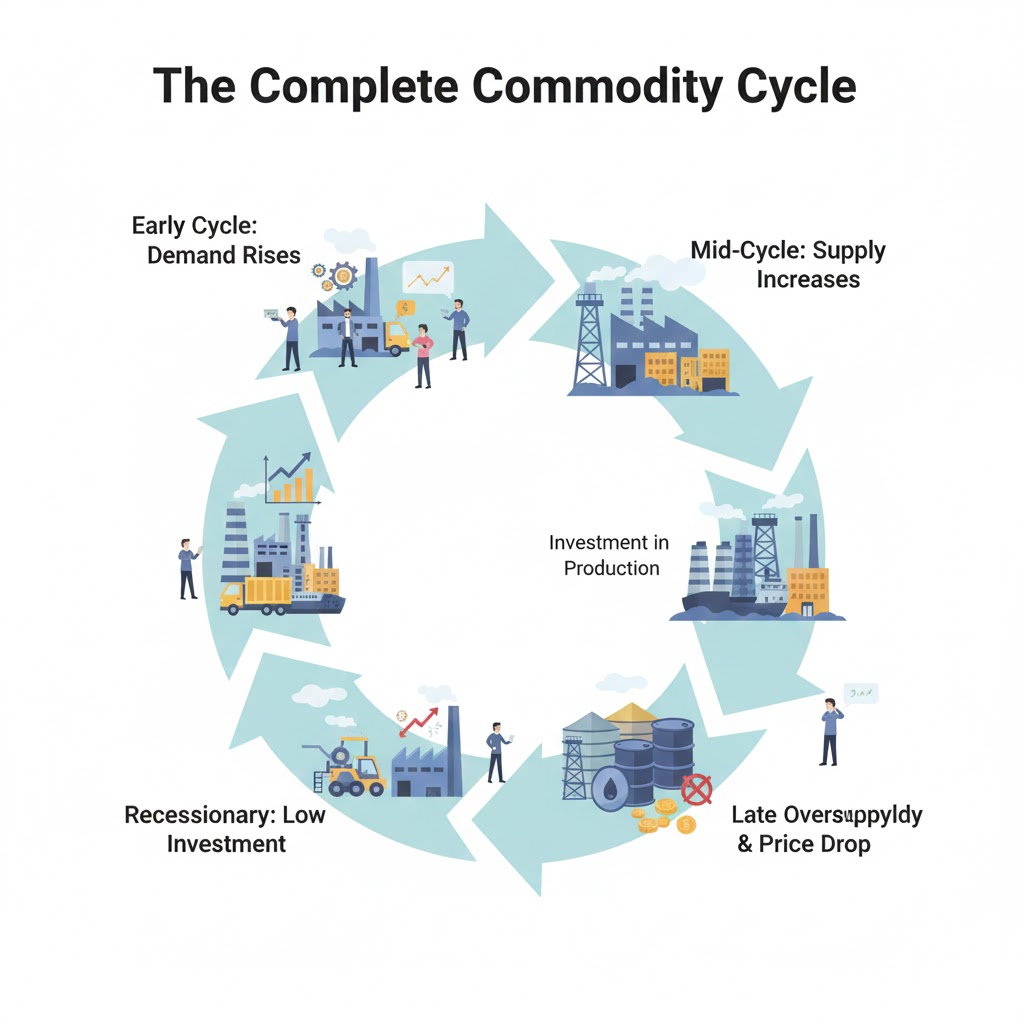
The 4 TRUE phases of a commodity cycle
I’ll label them the way professionals think about them.
PHASE 1 — Post-Bottom Recovery (END of old cycle / START of new one)
This is the TRUE beginning of a new cycle
What defines it (not price):
- Supply has already been destroyed
- Capex is near zero
- Project pipeline is empty
- Inventories stop building
- Nobody believes in the commodity
Price behavior:
- Low, volatile, boring
- Early rebound ignored
This is where fortunes are made.
Examples:
- Oil in 2020
- Coal in 2020–2021
- Uranium in 2017–2019
PHASE 2 — Tightening & Repricing
Supply is still constrained, demand improves modestly.
What defines it:
- Inventories draw
- Marginal supply returns slowly
- Prices move sharply higher
- Analysts upgrade forecasts
Price behavior:
- Strong, persistent uptrend
This is the easy money phase.
PHASE 3 — Investment Boom (MID-CYCLE PEAK SEEDING)
This is where most people think the cycle is still “good”.
What defines it:
- High prices justify new projects
- Capex surges
- Orderbooks explode
- Politicians encourage supply
- “This time is different” stories
Price behavior:
- High, volatile
- Can still go higher
⚠️ This phase plants the seeds of collapse.
Examples:
- Shipping 2021–2022
- Lithium 2022
- Nickel 2022–2023
PHASE 4 — Oversupply & Collapse (END of cycle)
This is the TRUE end of a cycle.
What defines it:
- New supply overwhelms demand
- Inventories balloon
- Prices fall below marginal cost
- Producers lose money
- Panic, layoffs, shutdowns
Price behavior:
- Downtrend
- False bottoms
- Long grind lower
This phase must run to completion before a new cycle can begin.
Examples:
- Iron ore 2015
- Oil 2014–2016
- Nickel (likely now)
So what exactly marks the BEGINNING?
The beginning of a new commodity cycle is NOT rising prices.
It is the END of forced supply destruction.
In practice:
- Mine closures stop increasing
- Capex cannot go any lower
- Supply stops falling
- Inventories stop building
Price can still be low or even falling.
And what marks the END?
The end of a commodity cycle is when high prices have induced too much supply.
In practice:
- Capex boom
- Projects everywhere
- Oversupply visible before prices collapse
- Everyone agrees it’s a great business
Price peaks before the cycle ends.
Why this matters for your current conclusion
If you said:
“There’s no buy in commodities right now”
That means:
- We’re between Phase 3 and Phase 4 in many markets
- Or early in Phase 4 (nickel, shipping, some agri)
This is the worst time to force entries.
One mental model to keep forever
Commodity cycles are decided by supply,
priced by capital,
and recognized by sentiment — in that order.
Most people reverse that.
Final clarity (this is the takeaway)
Price alone tells you neither
Beginning of cycle: supply destruction is finished
End of cycle: supply expansion has gone too far